
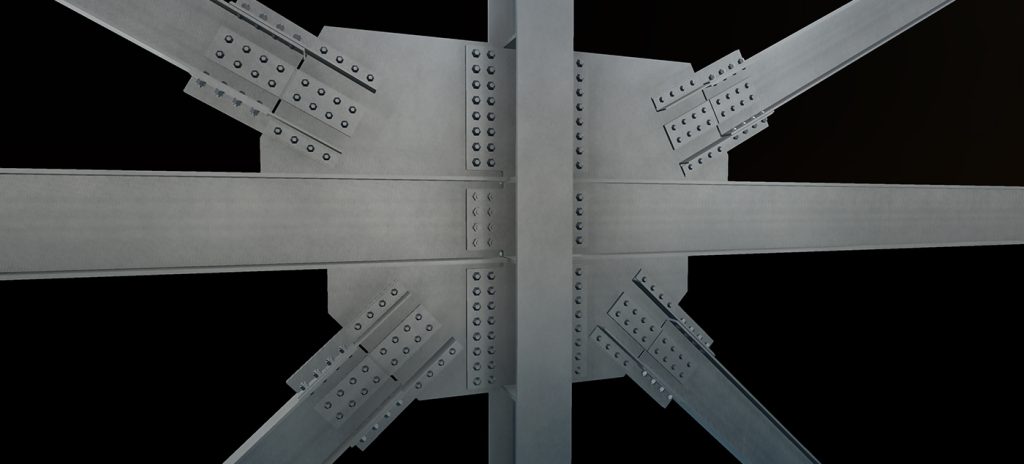
Connection design in steel detailing is a critical aspect of structural steel construction. It involves designing and detailing connections between steel members to ensure the stability and safety of the structure. Here are some key aspects of connection design in steel detailing:
- Types of Connections
1. Bolted Connections: These connections use bolts to join steel
members. They can be designed as slip-critical or bearing type
connections.
2. Welded Connections: These connections use welds to join steel
members. They can be designed as complete joint penetration (CJP)
or partial joint penetration (PJP) welds.
- Design Considerations
1. Symmetry: Connections should be designed to be symmetrical to
avoid eccentricity.
2. Slip Resistance: Slip-critical bolted connections should be designed
to resist slip at service loads and bearing failure at strength limit
states.
3. Weld Throat Thickness: Weld throat thickness should be designed
to resist the applied loads.
4. Material Grades: The material grades of the steel members and
connections should be compatible.
- Software Used
1. Ram Connection: A software used for connection design and analysis.
2. Idea Statica: A software used for connection design and analysis.
3. Limcon: A software used for connection design and analysis.
4. Descon Brace: A software used for connection design and analysis.
5. Risa Connection: A software used for connection design and analysis.
- Benefits of Proper Connection Design
1. Safety: Proper connection design ensures the stability and safety of
the structure.
2. Efficiency: Well-designed connections can reduce fabrication and
construction costs.
3. Reliability: Proper connection design can minimize the risk of failure
at joints.